
Thank you for writing to us. One of our executive will reach back to you through your submitted medium. In case there’s an urgency, feel free to connect over WhatsApp for faster response.
Prefer calling? Dial +9108048038864 (International callers) or 08048038864 (Indian callers).
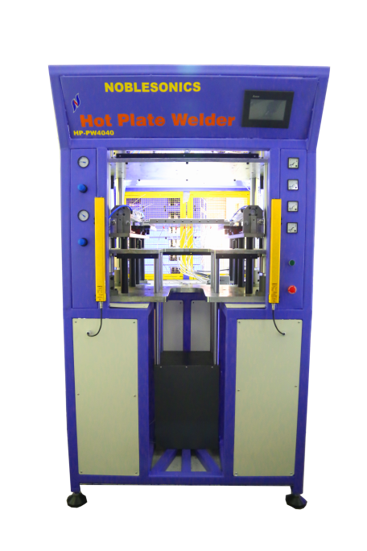
Hot plate welding is a type of thermal welding used to join thermoplastics. To melt the two surfaces to be joined, a heated tool is placed against them. The heat source is then removed, and the surfaces are pressed together.
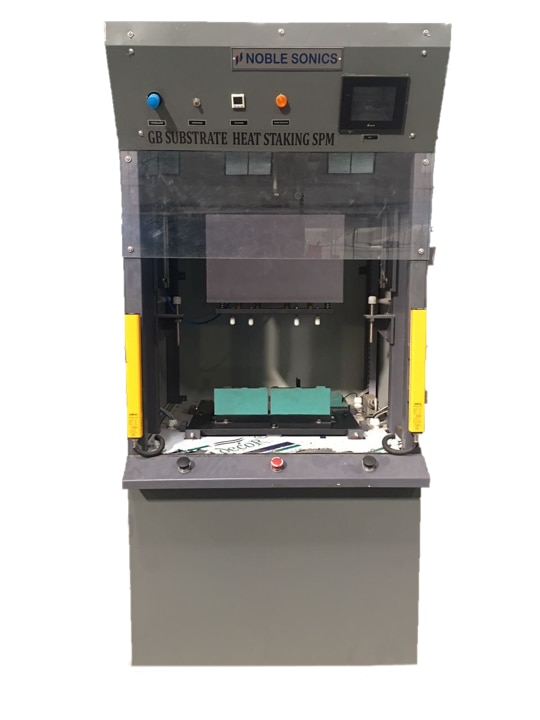
Heat Staking is a joining technology used to join two or more parts, at least one of which is made of plastic. The process uses heat and force to melt and deform the plastic material over a set period of time. The heated plunger with a defined profile cavity descends on the plastic stud. To achieve the desired profile, force is applied to the stud.
It is used to join dissimilar materials and large parts, such as car door trims, air ducts, and the instrument panel in a car.
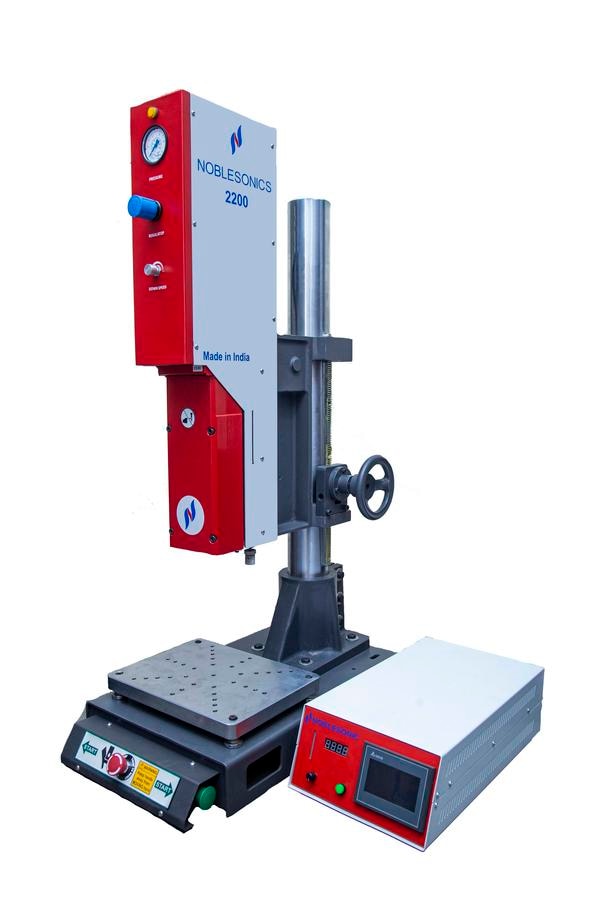
Ultrasonic welding (USW) is a welding technique that uses ultrasonic vibrations of high frequency to weld the two pieces together. It is most commonly used to weld thermoplastic materials and dissimilar materials.
A high frequency (15 kHz to 40 kHz) ultrasonic vibration is used to join two plastic pieces together. The high-frequency vibration generates heat energy at the interface of the two pieces and melts the material. The melted materials fused with each other to form a strong weld on cooling and solidification.
The typical frequency used is 15, 20, 30, 35 or 40 kHz.
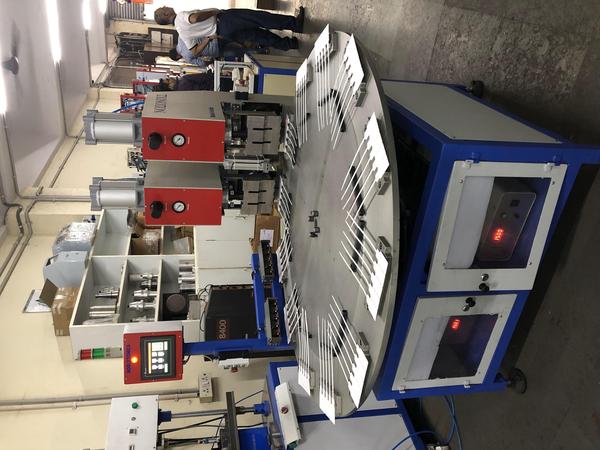
To maximize productivity and optimize human resources, we design and manufacture rotary indexing tables that are integrated with our ultrasonic welders. We also perform pre- and post-welding operations, such as testing and poka-yoke assembly.
speed of production Depending on the size and geometry of the parts, 40 parts per minute can be achievable.
Benefits
1. saving space
2. Enhance machine time utilisation
3. A consistent production rate throughout working hours and irrespective of operator skill.
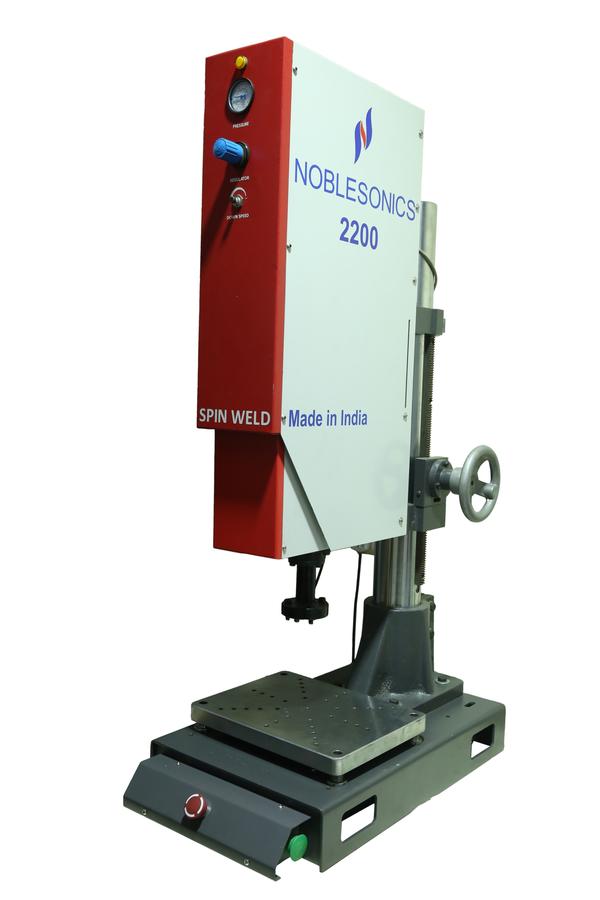
In order to fuse thermoplastic components with rotationally symmetric joints, the spin welding process uses heat generated by rotational friction at the joint line. The spin welding machine applies pressure axially while rotating one part against its stationary counterpart, and the resulting friction generates heat that melts the two pieces together.
Spin Welding Machines
Still searching for heat source?
Unit No.133, Raheja Tesla 1, Navi Mumbai TTC Industrial Area of MIDC, Juinagar, Navi Mumbai